



Gain access to personalized product screening, the best pricing, rewards, and more!
Create An Account, Or Sign In.


Your Product Analysis:
Home
Grass
Property
Kids or Pets
You Need:
$5.00
For your -- home1
Your Cost:
Your Cost:
$5.00
Price per
application2
application2
MONSANTO
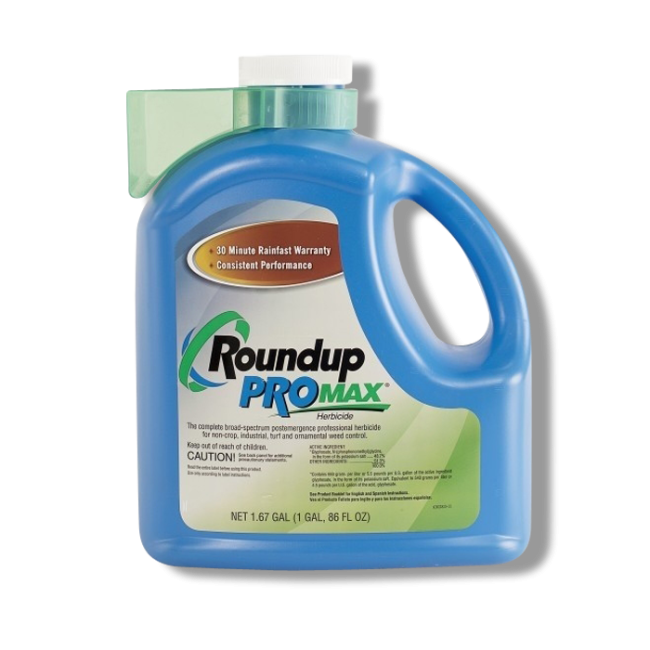
Roundup ProMax Herbicide
RoundUp ProMax is a non-selective post-emergent herbicide that delivers quick and efficient systemic control of a wide range of emerged annual and perennial weeds. Great to use on non-crop areas, industrial sites, turf, and ornamentals.
As low as
$58.50
Only %1 left
SKU
Roundup ProMax product page
Min : 58.5 - Max : 79.05
+

+
Price as of
08/20/26
08/20/26
Price Transparency
See how our pricing compares to other online retailers for this item.
Roundup ProMAX, manufactured by Monsanto, is a post-emergent systemic herbicide that delivers non-selective control of a wide range of annual weeds, perennial weeds, woody brush, and trees.
Roundup Pro Max comes in a water-soluble formulation and has a built-in surfactant in the formula.
When RoundUp ProMAX is applied onto a weed, it is absorbed by the plant, where it then prevents the plant from attaining photosynthesis and gathering nutrients to sustain itself. Roundup is then transported throughout the weed to kill the entire weed down to the root.

Tools Needed
Roundup ProMax can be applied through a wide range of spray equipment like a backpack sprayer or a spraying rig. For the average home application, a hand-pump sprayer should do.
How to Use
- Step 1: Determine how much product you will need by first calculating the square footage of the area you wish to treat. To do this, measure and multiply the area length times the width (length x width = square footage). Rates for RoundUp Promax vary depending on the concentration ratio from 0.4% concentration (0.5 oz. per gallon per 1,000 sq. ft.) to a 7% concentration (9 oz. per gallon per 1,000 sq. ft.). When using RoundUp Promax, typically it takes 2 oz. of concentrate per gallon of water for most general applications. Brush and Vines will require 5-9 oz. of solution per gallon of water.
- Step 2: Fill the spray tank with the required amount of water and then the appropriate amount of Roundup ProMax. Fill with the remaining half of water and then close the lid and agitate the sprayer to ensure the product is well-mixed.
- Step 3: Apply the solution to the desired area via fan spray setting for uniform coverage. Spray generously but not to the point of runoff. Plants should die within 24 hours. If not, reapply after 7 to 10 days for particularly stubborn weeds.
Where to Use
Use RoundUp ProMax is ideal to be used in non-crop areas such as airports, apartment complexes, commercial sites, ditch banks, driveways, dry ditches, dry canals, fencerows, golf courses, greenhouses, industrial sites, landscape areas, lumber yards, manufacturing sites, municipal sites, natural areas, office complexes, ornamentals, parks, parking areas, pastures, petroleum tank farms and pumping installations, public areas, railroads, rangeland, recreation areas, residential areas, rights-of-way, roadsides, schools, shade houses, sports complexes, storage areas, substations, turfgrass areas, utility sites, warehouse areas, and wildlife management areas.
When to Use
Applying RoundUp ProMax should be done when weeds are young and actively growing. If weeds are going through stress, such as during a drought or cool temperatures, you made need to apply a higher dosage to get the weeds to die out.
Safety Information
Roundup ProMax is safe to use when applied according to label directions. Make sure to wear the proper PPE when applying this product (goggles, gloves, face mask, etc). After treatment, keep pets and children away from the treated area until the product as dried.
Special Considerations
Apply Roundup ProMax to foliage on a coarse spray setting. Spray to wet and make it uniform. It would be wise to use a spray pattern indicator to keep track of your spraying and avoid over spraying with RoundUp ProMax.
| Restricted Use | No |
|---|---|
| Shipping Restrictions | MN |
| Availability | Online |
| Signal Word | CAUTION |
| Keith's Pro Tip | "RoundUp Pro Max is non-selective, meaning it kills any plant it touches, so you have to be very careful spraying it in areas where you have desired vegetation. Coverage of the top one-half of the plant is important for best results" |
| Target Pests Multi | Alfalfa, Alligatorweed, Anise Fennel, Annual Bluegrass, Annual Fleabane, Annual Sowthistle, Annual Spurge, Artichoke Thistle, Bahiagrass, Barnyardgrass, Bentgrass, Bermudagrass, Bittercress, Black Nightshade, Blue Mustard, Blue Vervain, Bohemian Knotweed, Bracken Fern, Bristly Starbur, Broadleaf Signalgrass, Broomsedge, Browntop Panicum, Bulbous Bluegrass, Buttercup, Canada Thistle, Carolina Foxtail, Carolina Geranium, Castorbean, Cattail, Cereal Rye, Cheatgrass, Chervil, Chickweed, Cocklebur, Cogongrass, Common Groundsel, Common Milkweed, Common Mullein, Common Pokeweed, Common Purslane, Common Ragweed, Common Rye, Corn, Corn Speedwell, Corn Volunteer, Coyote Brush, Crabgrass, Curly Dock, Dallisgrass, Dandelion, Deerweed, Dewberry, Downy Brome, Dwarfdandelion, Eastern Mannagrass, Eclipta, European Beachgrass, Fall Panicum, False Dandelion, Fescue, Fiddleneck, Field Bindweed, Field Horsetail, Field Pennycress, Field Sandbur, Filaree, Fivehook Bassia, Florida Beggarweed, Florida Pusley, Foxtail, German Ivy, Giant Hogweed, Giant Ragweed, Goosegrass, Grain Sorghum, Guineagrass, Hairy Fleabane, Hemp Dogbane, Hemp Sesbania, Henbit, Honeysuckle, Horsenettle, Horseradish, Horseweed/Marestail, Iceplant, Itchgrass, Japanese Brome, Japanese Knotweed, Jerusalem Artichoke, Johnsongrass, Jointed Goatgrass, Junglerice, Kentucky Bluegrass, Kikuyugrass, Knapweed, Knotgrass, Knotweed, Kochia, Kudzu, Ladysthumb, Lambsquarters, Lantana, Leafy Spurge, Lespedeza, Little Barley, London Rocket, Mayweed, Medusahead, Milkweed, Morningglory, Multiflora Rose, Musk Thistle, Napier Grass, Oak, Oat, Pennsylvania Smartweed, Perennial Ryegrass, Phragmites, Pigweed, Plains Coreopsis, Poison Hemlock, Poison Ivy, Poison Oak, Poorjoe, Prickly Lettuce, Prickly Sida, Prostrate Spurge, Puncture Vine, Purple Nutsedge, Purslane Speedwell, Quackgrass, Quaking Aspen, Raspberry, Red Clover, Red Rice, Redroot Pigweed, Redvine, Reed Canarygrass, Rough Fleabane, Russian Thistle, Rye, Ryegrass, Seedling Johnsongrass, Shattercane, Shepherdspurse, Sicklepod, Silverleaf Nightshade, Smallseed Falseflax, Smutgrass, Soft Chess, Spanishneedles, Spotted Spurge, Sprangletop, Spurred Anoda, Stinkgrass, Sunflower, Tall Fescue, Tansy Mustard, Teaweed, Texas Blueweed, Texas Panicum, Timothy, Torpedograss, Trumpet Creeper, Tumble Mustard, Umbrella Spurry, Vaseygrass, Velvetleaf, Virginia Copperleaf, Virginia Creeper, Virginia Pepperweed, Western Wheatgrass, Wheat, White Clover, Wild Mustard, Wild Oats, Wild Sweet Potato, Willow, Wirestem Muhly, Witchgrass, Woolly Cupgrass, Woollyleaf Bursage, Yellow Rocket, Yellow Starthistle, Yellow_Nutsedge, Alder, American Hornbean, Ash, Barley, Beech, Birch, Bitter Cherry, Black Cherry, Black Gum, Black Locust, Black Oak, Black Sage, Blackberry, Bracken, Brazilian Peppertree, California Buckwheat, California Sagebrush, Cascara, Catsclaw, Ceanothus, Chamise, Chinese Tallowtree, Dogfennel, Dogwood, Eastern Redbud, Elderberry, Elm, Eucalyptus, Florida Holly, French Broom, Gorse, Hasardia, Hawthorn, Hazel, Hickory, Madrone Resprouts, Manzanita, Monkey Flower, Northern Oak, Persimmon, Pin Cherry, Pine, Poison Sumac, Poplar, Post Oak, Red Maple, Salmonberry, Salt Cedar, Sassafras, Scotch Broom, Smooth Sumac, Sourwood, Southern Red Oak, Southern Waxmyrtle, Sugar Maple, Sugarbush Sumac, Sweet Gum, Swordfern, Sycamore, Tan Oaks Resprouts, Thimbleberry, Tobacco Tree, Toyon, Vine Maple, White Oak, Winged Sumac, Yellow Poplar, Yerbasenta |
| Time to Kill | This product moves through the plant from the point of foliage contact and into the root system. Visible effects on most annual weeds occur within 1 day, and on most perennial weeds in 2 days. - |
| Chemical Type | Herbicide |
| Formulation | Emulsifiable Concentrate (EC) |
| Application Methods | Broadcast Spray, Spot Treatment |
| Product Drawbacks | Is a kill-all herbicide so you have to be very careful when applying it so you don't accidentally damaged desired vegetation. |
| Active Ingredient | Glyphosate - 48.7% |
| Application Equipment | Pump Sprayer, Spray Rig |
| Mix Rate | 2 oz. of concentrate per gallon of water for most applications. Brush and Vines will require 5-9 oz. of solution per gallon of water. Please see the label for complete use instructions. For more specific application rates please refer to the label. |
| Use Sites | Outdoors |
| Yield | Uniform and complete spray coverage will provide best results. Do not spray weed foliage to the point of runoff. |
| EPA Registration No. | 524-579 |
| Shelf Life | RoundUp ProMax can last for 1 to 3 years in storage when kept in a cool, dry place. |
| Comparable Products | Glyphosate 4 |
| Children or pets? | No |
| Property Characteristics | None |
| Availability | Online |
| Restricted Use | No |
| Brand | MONSANTO |
| Keith's Pro Tips | "RoundUp Pro Max is non-selective, meaning it kills any plant it touches, so you have to be very careful spraying it in areas where you have desired vegetation. Coverage of the top one-half of the plant is important for best results" |
| Product Drawbacks | Is a kill-all herbicide so you have to be very careful when applying it so you don't accidentally damaged desired vegetation. |
| Target Pests | Roundup ProMax is labeled for use on the following: Annual Sowthistle, Annual Spurge, Bahiagrass, Barley, Bermudagrass, Bittercress, Blackgum, Blue Mustard, Blue Vervain, Bristly Starbur, Broadleaf Signalgrass, Broomsedge, Browntop Panicum, Bulbous Bluegrass, Buttercup, Canada Thistle, Carolina Foxtail, Castorbean, Cheatgrass, Cheeseweed, Chervil, Chickweed, Cocklebur, Common Groundsel, Common Purslane, Common Ragweed, Common Rye, Corn, Corn Speedwell, Crabgrass, Curly Dock, Dallisgrass, Dogfennel, Dwarfdandelion, Eastern Mannagrass, Eclipta, Facebook Bassia, Fall Panicum, Fiddleneck, Field Sandbur, Filaree, Florida Beggarweed, Giant Ragweed, Goosegrass, Grain Sorghum, Guineagrass, Hemp Dogbane, Hemp Sebania, Henbit, Hickory, Hophorbeam Copperleaf, Horseweed, Itchgrass, Japanese Brome, Johnsongrass, Jointed Goatgrass, Junglerice, Knotweed, Kochia, Ladysthumb Smartweed, Lamb's-quarter, Little Barley, London Rocket, Mayweed, Medusahead, Milkweed, Morningglory, Musk Thistle, Oak, Oats, Pennsylvania Smartweed, Pigweed, Plains Coreopsis, Poorjoe, Prickly Lettuce, Prostrate Spurge, Puncture Vine, Purslane Speedwell, Quackgrass, Red Maple, Red Rice, Redroot Pigweed, Russian Thistle, Rye, Ryegrass, Seedling Johnsongrass, Shattercane, Shepard's-purse, Sicklepod, Silver Bluestem, Silverleaf Nightshade, Smallseed Flaseflax, Smutgrass, Spanishneedles, Spotted Spurge, Sprangletop, Spurred Anoda, Stinkgrass, Sunflower, Sweetgum, Sycamore, Tall Fescue, Tansy Mustard, Texas Panicum, Tickweed Coreopsis, Trumpetcreeper, Tumble Mustard, Umbrella Spurry, Vaseygrass, Velvetleaf, Virginia Copperleaf, Virginia Pepperweed, Volunteer Corn, Wheat, Wild Mustard, Wild Oats, Witchgrass, and Yellow Starthistle. |
| Application Equipment | Pump Sprayer, Spray Rig |
| Application Methods | Broadcast Spray, Spot Treatment |
| Active Ingredient | Glyphosate - 48.7% |
| Product Type | Herbicide |
| Formulation | Emulsifiable Concentrate (EC) |
| Application Rate | 2 oz. of concentrate per gallon of water for most applications. Brush and Vines will require 5-9 oz. of solution per gallon of water. Please see the label for complete use instructions. For more specific application rates please refer to the label. |
| Shelf Life | RoundUp ProMax can last for 1 to 3 years in storage when kept in a cool, dry place. |
| Yield | Uniform and complete spray coverage will provide best results. Do not spray weed foliage to the point of runoff. |
| Use Sites | Outdoors |
| Time to Kill | This product moves through the plant from the point of foliage contact and into the root system. Visible effects on most annual weeds occur within 1 day, and on most perennial weeds in 2 days. - |
| Comparable Products | Glyphosate 4 |
| Use Caution On | Bentgrass, Bermudagrass, Kentucky Bluegrass, Fescue, Fine, Fescue, Tall, Kikuyugrass, Ryegrass, St Augustine, Zoysiagrass |
| Incompatible Home Siding | Brick, Hardie Plank, Stone Veneer, Stucco, Wood, Vinyl |
| EPA Registration # | 524-579 |
