



Gain access to personalized product screening, the best pricing, rewards, and more!
Create An Account, Or Sign In.
Most Effective Products
Johnsongrass Control: How To Get Rid of Johnsongrass
This page is a general Johnsongrass control guide. Using the products and methods suggested, you will get control of Johnsongrass. Follow this guide and use the recommended products, and we guarantee 100% control of Johnsongrass.
Johnsongrass is a warm-season perennial grass weed that is hated by agricultural farmers because its presence reduces yields in corn, grain sorghum, soybean, cotton, and leguminous forages. The weed got its name from a farmer who introduced the species to his farm in Alabama in 1840s, Colonel William Johnson. Now, Johnsongrass is found in nearly every state in the country except for Minnesota and has been labeled a noxious weed in 19 states.
Johnsongrass is native to the Mediterranean and was initially introduced to North America in 1830 as a forage crop and for stabilizing ditches. Since then, it has been an eyesore and headache to get rid of for agricultural and residential areas because of its tendency to crowd out desirable plants and destroying food and shelter for wildlife.
A single plant of Johnsongrass can produce over 5,000 seeds which can lay dormant for up to 20 years. This weed is especially tough because it can be poisonous to cattle and horses. If you get an early frost or an extreme drought, you cannot let cattle and horses graze on any johnsongrass because it contains enough hydrogen cyanide to actually kill cattle and horses which can be a serious worry.
Our lawn care experts have put together this guide to show you exactly what you need to remove Johnsongrass from your property permanently. Follow our step-by-step instructions below and use our recommended products to the side to be successful in getting rid of Johnsongrass.
Identification
Before you can carry out treatment applications, you need to identify and be sure the weed you are dealing with is Johnsongrass and not some other weed. Misidentification can lead to choosing the wrong herbicides, which can be a waste of time and money.

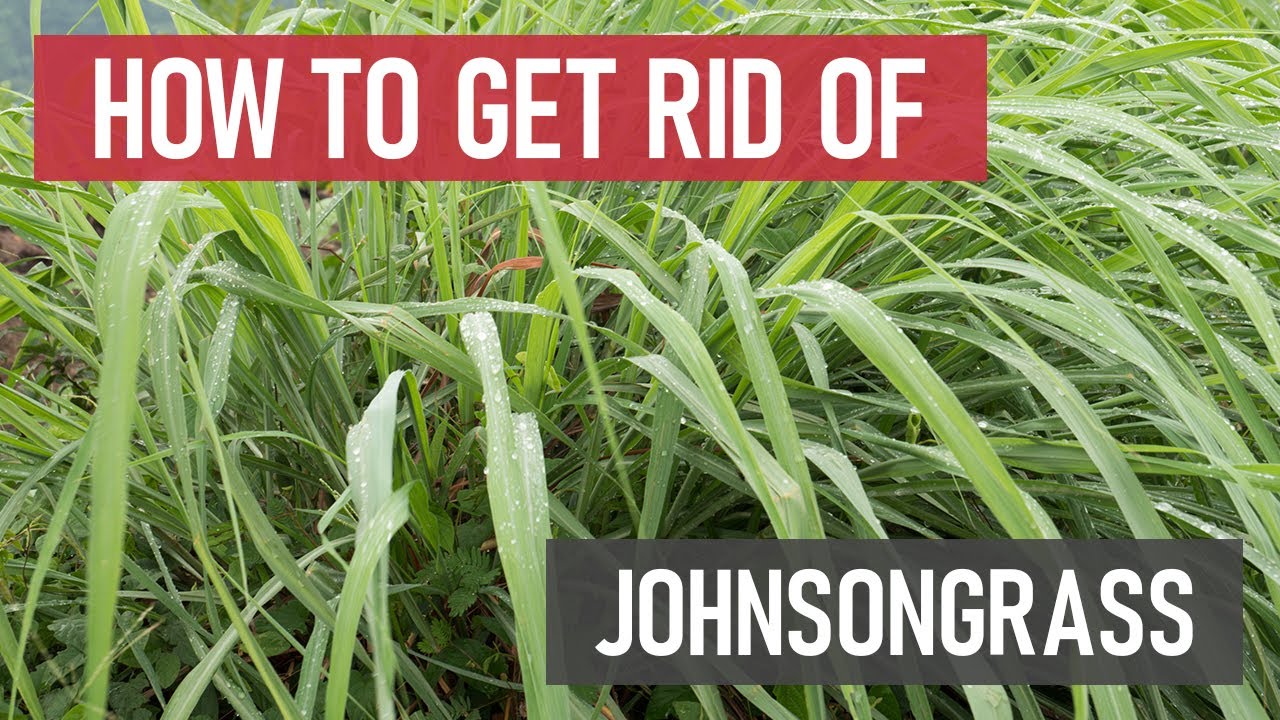
- Johnsongrass is a warm-seasoned perennial grass that grows in clumps or patches and reaches up to 3 to 7 feet tall from a stout rhizome. Stems are unbranched and usually hairless, but they can be found along the margins sometimes.
- Leaves grow 6 to 20 inches in height and are 10 to 30 millimeters wide. They are also rolled in the shoot. The leaves have prominent white midveins, and they are usually hairless on both sides.
- The various seeds that Johnsongrass grows can be greenish to purple in color when young and a dark-reddish brown when more mature. These seeds can also resemble a young corn seeding, but can be easily identified by its football to egg shape and its stems, which are more narrower and hairless.
- From May to October, the inflorescence or flower head takes on an open panicle shape.
Use our description and image above to help you to identify Johnsongrass correctly. If you are not sure whether the weed on your lawn is Johnsongrass, contact us and we will properly ID the plant for you as well as give you product recommendations for control.
Inspection
Once you have confirmed that you are dealing with Johnsongrass, you can then carry out an inspection. During this phase, you will need to locate the areas where Johnsongrass is growing most and analyze the conditions that are conducive to Johnsongrass thriving in the area. This will help you to determine your treatment approach and where to focus herbicide applications.
Where to Inspect
Johnsongrass is typically found in areas with moist, fertile soil.
Common sites for this weed to be found are lawns, crop fields, open forests, ditches, waste grounds, roadsides, pastures, irrigation canals, other disturbed sites, wetlands, and along creeks and river banks.
What To Look For
Johnsongrass will begin to germinate when soil conditions have reached between 60-70 degrees Fahrenheit.
They can be easily found due to its dense growth habit and will become more stout in its later growth stages.
Treatment
Before chemical application, make sure to equip yourself with personal protective equipment for your personal safety (Glasses, gloves and particle mask).
We recommend applying a selective, post-emergent herbicide like Certainty Turf Herbicide.
We recommend you check out Certainty Turf Herbicide. Certainty is a water-dispersible granule made with Sulfosulfuron and controls weeds in warm-season turf.
Step 1: Mix and Apply Certainty Herbicide
Determine how much Certainty Turf Herbicide to use by measuring the square footage of the treatment area. To do this, measure the length and width of the treatment area in feet then multiply them together (length X width = square footage). For acreage, take the square footage and divide it by one acre (square footage / 43,560 sq. ft. = acres).
To get rid of Johnsongrass, use 0.75 oz. of Certainty Turf Herbicide per 2 gallons of water per 1,000 sq. ft.
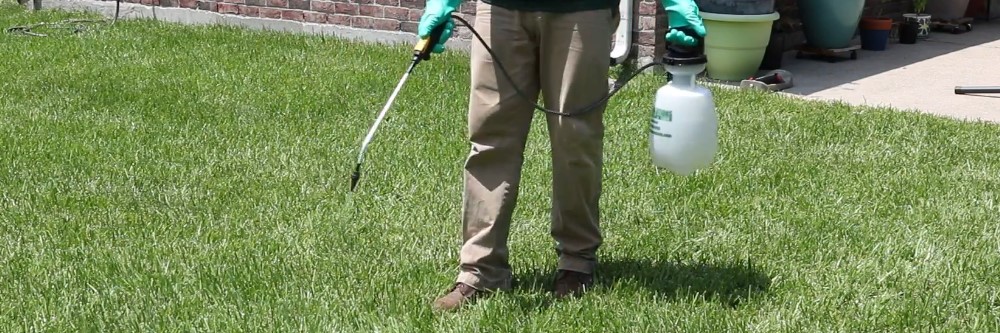
We recommend mixing and spraying with a handheld pump sprayer or backpack sprayer.
Fill your sprayer 3/4ths of the way with water then add in the appropriate amount of Certainty Turf Herbicide. Fill the rest of the way with remaining half of water and shake the sprayer.
Once the product is well-mixed in your sprayer, apply the product to the Johnsongrass using a fan or cone nozzle setting. Spray the weeds to the point of wet, but not runoff.
Reapply when 4 or more weeks have passed from the first application if this weed is still present on your property.
Prevention
Once Johnsongrass has been eliminated from your property, you will need to implement some preventative measures which will ensure that this weed does not return.

- To prevent Johnsongrass from returning to your yard we recommend applying a pre-emergent herbicide like Barricade Pre-Emergent Herbicide Prodiamine Granular. Depending on your turf grass species, you’ll apply 1.5 to 4 pounds of product per 1,000 square feet. After application, water in the product with at least half an inch of water. Keep in mind that this product will control Johnsongrass from seed.
- Aside from this, the best defense against Johnsongrass is keeping your turf thick and healthy to discourage undesired plants from establishing. Mow at the right height and address any bare spots or thinning via reseeding. If your lawn is lush and strong it will outcompete weeds like Johnsongrass.
Key Takeaways
What is Johnsongrass?
- Johnsongrass is an aggressive perennial weed that is known to be resistant to herbicide treatments and can get out of control in a hurry.
How to Get Rid of Johnsongrass
- We recommend using a post-emergent treatment of Certainty Turf Herbicide to eliminate Johnsongrass.
Preventing Johnsongrass Reinfestation
- To prevent a return of Johnsongrass, we recommend applying Barricade Pre-Emergent Herbicide Prodiamine Granular and keep up a good lawn maintenance schedule that to promote a thick, healthy lawn.


