



Gain access to personalized product screening, the best pricing, rewards, and more!
Create An Account, Or Sign In.


FMC TECHNOLOGIES
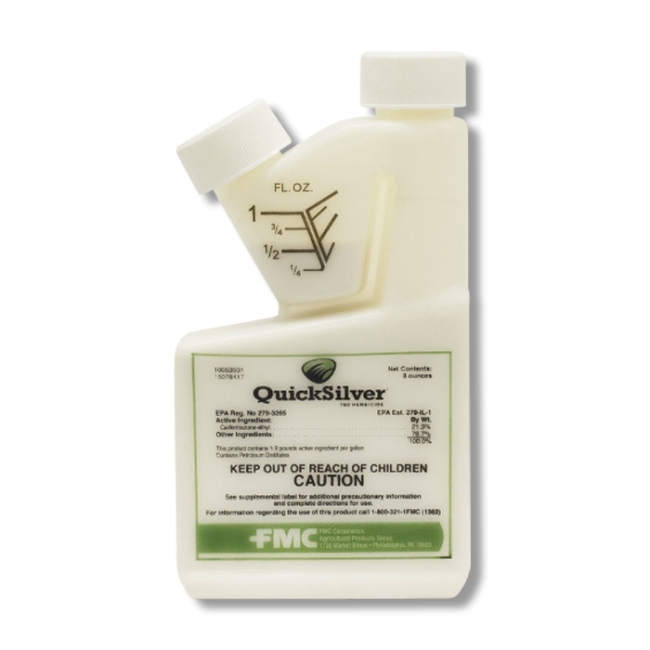
Quicksilver T&O Herbicide
Quicksilver Herbicide is a selective post-emergent herbicide made to control a wide range of annual, biennial and perennial broadleaf weeds. Is great for controlling silvery thread moss that might develop in turfs and golf courses.
As low as
$170.95
Only %1 left
SKU
Quicksilver Herbicide product page
Min : 170.95 - Max : 170.95
+

Price as of
08/20/26
08/20/26
Price Transparency
See how our pricing compares to other online retailers for this item.
Quicksilver T&O Herbicide, manufactured by FMC Technologies, is specially formulated for selective post-emergent broadleaf weed control on industrial sites, rangelands, rights-of-ways, and fencerows. Q
This suspended concentrate works great on weeds and moss with its fast-acting formula that penetrates into the plants’ cells. You will noticeably see a difference in about 24 hours or less.
Quicksilver herbicide has been tested by universities and golf courses and demonstrates no signs of phytotoxicity. Enlist Quicksilver to finally destroy the weed and moss growing in your lawn or golf course.
Tools Needed
Quicksilver Herbicide needs to be applied with either a hose-end sprayer, handheld pump sprayer, backpack sprayer, or spray rig. For small lawn jobs, we recommend a handheld 1-gallon pump sprayer or a 4-gallon backpack sprayer.
How to Use
- Step 1: Determine how much Quicksilver T&O Herbicide you will need to apply by first calculating the square footage of the area you wish to treat. To do this, measure and multiply the area length times the width (length x width (in feet) = square footage). Quicksilver can be used as a stand-alone product or mixed with other herbicides. As a stand-alone, apply Quicksilver T&O Herbicide using 0.023 to 0.048 fl. oz. per 1,000 sq. ft. For acreage applications, use 0.9 to 2.1 oz. of product per 20 to 175 gallons of water per acre. For spot treatments, use 0.030 fl. oz. of Quicksilver in 1 to 2 gallons of water to treat 1,000 sq. ft. For example, if you calculated a treatment are of 3,000 sq. ft, you will need to mix 0.090 fl. oz. of Quicksilver in at least 3 gallons of water. Do not apply more than 6.7 oz. of product per acre per application.
- Step 2: Fill you sprayer halfway with the required amount of water then add the appropriate measured amount of Quicksilver Herbicide based on your calculations. Add the remaining half of water to the sprayer and then close the lid and agitate the sprayer until the product is well-mixed.
- Step 3: Spray target weeds until wet but avoid spray solution runoff and over application. A good technique to put into practice is to avoid side-to-side movement of the nozzle when spraying as it is best to spray the nozzle directly with no movement close to the weeds or moss to ensure proper application.
- Step 4: If you believe a secondary application is needed to properly treat an area, wait two weeks after the initial application and reapply.
Where to Use
Quicklsilver Herbicide can be used in and around ornamental lawns, turfgrass, stone-covered yards established in institutional, ornamental, residential/domestic sites, apartment complexes, condominiums, patient care areas of nursing homes, mental institutions, hospitals, convalescent homes, hospitals, schools, museums, libraries, sports facilities, golf courses, and office buildings.
Warm-seasoned grasses to be treated are common and hybrid bermudagrass, bahiagrass, buffalograss, centipedegrass. seashore paspalum, St. Augustine grass, and zoysiagrass.
Cool-seasoned grasses to be treated are creeping bentgrass, colonial bentgrass, annual bluegrass, Kentucky bluegrass, fine fescues, red fescues, tall fescues, and perennial ryegrass.
When to Use
Quickilver should be used when there are unwanted weeds growing on the property. Prime times for application is in the early spring season when weeds are beginning to emerge.
Apply Quicksilver T&O Herbicide when turfgrasses are well-established as injury may occur to underdeveloped lawns.
Applications to dormant warm-seasoned grasses are permitted. Avoid applications when warm-seasoned grasses are transitioning into or out of dormancy.
Safety Information
Quicksilver T&O Herbicide is safe to use around children and pets when applied according to the product label instructions. Always wear the proper personal protective equipment (PPE) when mixing and applying this product.
Do not enter nor allow others and pets to enter treated areas until sprays have dried.
Keep out of reach of children and animals.
Special Considerations
Quicksilver T&O Herbicide can be used with a surfactant if needed depending on the treatment area.
Though warm season grasses are generally tolerant to Quicksilver applications, slight yellowing may occur 3 to 7 days after treatment if the grass is under stress. If you are unsure, you can check for turf tolerance by spraying your solution in a small area and observing the results.
| Restricted Use | No |
|---|---|
| Availability | Online |
| Signal Word | CAUTION |
| Keith's Pro Tip | "Quicksilver works fast and can kill plants totally within 72 hours. Make sure when spraying that you use a fan spray setting for even coverage." |
| Target Pests Multi | Annual Morningglory , Black Medic, Canada Thistle, Carolina Geranium, Carpetweed, Catchweed Bedstraw, Chickweed, Coast Fiddleneck, Common Groundsel, Common Lambsquarters, Common Mallow, Common Purslane, Common Ragweed, Corn Speedwell, Dandelion, Dayflower, Deadnettle, Dollarweed, Evening Primrose, Field Pennycress, Field Speedwell, Field Violet, Fleabane, Florida Beggarweed, Florida Betony, Florida Pusley, Hairy Beggarticks, Healall, Hemp Sesbania, Henbit, Horseweed/Marestail, Ivyleaf Speedwell, Kochia, Ladysthumb, Lawn Burweed, Little Mallow, London Rocket, Nightshade, Old World Diamond Flower, Parsley Piert, Pennsylvania Smartweed, Perennial Sowthistle, Persian Speedwell, Pigweed, Plantain, Prickly Sida, Prostrate_Knotweed, Red Sorrel, Redstem Filaree, Shepherdspurse, Silvery Thread Moss, Small-flowered Bittercress, Sowthistle, Spotted Spurge, Virginia Buttonweed, White Clover, Wild Buckwheat, Wild Lettuce, Wild Mustard, Yellow_Woodsorrel, Ground Ivy, Wild Violet, Algae |
| Time to Kill | Quicksilver Herbicide begins to kill immediately as soon as the target weeds are contacted by the chemical, and only takes approximately 72 hours to kill off most unwanted weeds if caught in early stages 1-4 inches in height. |
| Chemical Type | Herbicide |
| Formulation | Suspended Concentrate |
| Application Methods | Broadcast Spray, Spot Treatment |
| Product Drawbacks | Needs a surfactant to improve effectiveness. |
| Active Ingredient | Carfentrazone-ethyl 21.3% |
| Application Equipment | Backpack Sprayer, Pump Sprayer, Spray Rig |
| Mix Rate | Quicksilver Herbicide is mixed at a rate of 0.9 to 2.1 oz. of Quicksilver T&O Herbicide per 20 to 175 gallons of water per acre. Spot treatments are applied at 0.030 fl. oz. in 1 gallon of water per 1,000 sq. ft. |
| Use Sites | Outdoors |
| Yield | Each finished gallon of Quicksilver Herbicide should cover approximately 1,000 square feet and an 8oz bottle should treat between 4,000 and 32,000 square feet depending on mix rate. |
| EPA Registration No. | 279-3265 |
| Shelf Life | Quicksilver can last up to 3 years in storage when kept in a cool, dry place and avoid excess heat. |
| Comparable Products | Tribute Total Herbicide |
| Children or pets? | No |
| Property Characteristics | None |
| Availability | Online |
| Restricted Use | No |
| Brand | FMC TECHNOLOGIES |
| Keith's Pro Tips | "Quicksilver works fast and can kill plants totally within 72 hours. Make sure when spraying that you use a fan spray setting for even coverage." |
| Product Drawbacks | Needs a surfactant to improve effectiveness. |
| Target Pests | Algae, Silvery Thread Moss, Annual Morningglory spp, Annual Sowthistle, Black Medic, Canada Thistle, Carolina Geranium, Carpetweed, Catchweed Bedstraw, Coast Fiddleneck, Common Chickweed, Common Dayflower, Common Groundsel, Common Lambsquarters, Common Mallow, Common Purslane, Common Ragweed, Corn Speedwell, Cutleaf Eveningprimrose, Dandelion, Deadnettle spp, Dollarweed, Field Pennycress, Field speedwell, Field Violet, FL Beggarweed, FL Betony, FL Pusley, Fleabane, Ground Ivy, Hairy Beggarticks, Healall, Hemp Sesbania, Henbit, Horseweed, Ivyleaf Speedwell, Kochia, Ladysthumb, Lawn Burweed, Little Mallow, London Rocket, Nightshade spp, Old-world Diamond-flower, PA Smartweed, Parsley-piert, Perennial Sowthistle, Persian Speedwell, Pigweed spp, Plantain spp, Prickly Sida, Prostrate Knotweed, Red Sorrel, Redstem Filaree, Shepard's-purse, Small-flowered Bittercress, Smallflowered Bittercress, Spotted Spurge, VA Buttonweed, White Clover, Wild Buckwheat, Wild Lettuce, Wild Mustard, Wild Violet, and Yellow Wood Sorrel. |
| Application Equipment | Backpack Sprayer, Pump Sprayer, Spray Rig |
| Application Methods | Broadcast Spray, Spot Treatment |
| Active Ingredient | Carfentrazone-ethyl 21.3% |
| Product Type | Herbicide |
| Formulation | Suspended Concentrate |
| Application Rate | Quicksilver Herbicide is mixed at a rate of 0.9 to 2.1 oz. of Quicksilver T&O Herbicide per 20 to 175 gallons of water per acre. Spot treatments are applied at 0.030 fl. oz. in 1 gallon of water per 1,000 sq. ft. |
| Shelf Life | Quicksilver can last up to 3 years in storage when kept in a cool, dry place and avoid excess heat. |
| Yield | Each finished gallon of Quicksilver Herbicide should cover approximately 1,000 square feet and an 8oz bottle should treat between 4,000 and 32,000 square feet depending on mix rate. |
| Use Sites | Outdoors |
| Time to Kill | Quicksilver Herbicide begins to kill immediately as soon as the target weeds are contacted by the chemical, and only takes approximately 72 hours to kill off most unwanted weeds if caught in early stages 1-4 inches in height. |
| Comparable Products | Tribute Total Herbicide |
| EPA Registration # | 279-3265 |
